Blog
600 Entries

Check back here for detailed information on updates to the reading orders or database, reviews by myself or any of the other site contributors, and general comic news we find interesting! You can also subscribe to an RSS feed for updates.

If you’re new here, you may want to know How To Use This Website. Alternatively, click on a reading order on the sidebar. The current pride of our site is the Recommended Reading Order for the entire DC Universe!

Page 2 of 12112345...10203040...Last »
Up Down
Page 2 of 12112345...10203040...Last »
By | Sunday, March 31, 2013 | 10:23 am | 0 Comments | Blog > Reviews
 
Find This Book At:
Ebay (Search by Title)
Ebay (ISBN/Softcover)
Half.com (Softcover)
Amazon (Softcover)
View our database entry (coming soon!)
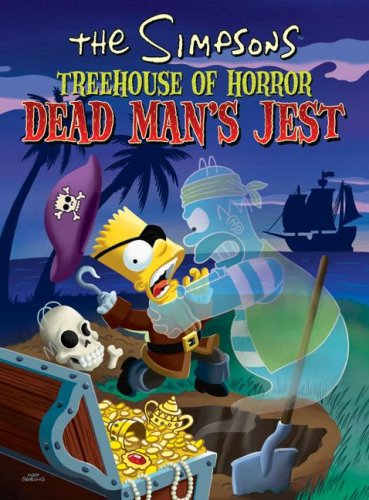
Includes Issues:Bart Simpson’s Treehouse of Horror #10-11
Issue Dates:September 2004 – September 2005
Creator:
Matt Groening

This review is spoiler-free! Skip To The Verdict? »

Treehouse1Two words I don’t want to read in another review anytime soon are “love” and “letter.” It’s not a very high compliment to pay a comic book that the best thing it does is remind you of better comics. Ultimately we’re not going to remember the love letter when we have its subject to admire.

Treehouse of Horror is not a love letter to Tales from the Crypt. Treehouse of Horror is the real thing.

Dead Man’s Jest starts with issue 10, featuring four stories respectively plotted or conceived by metal artists Gene Simmons, Alice Cooper, Rob Zombie and Pat Boone. The issue isn’t one of my favorites as I feel that it suffers for being a little indulgent of its guest talent, but nevertheless stands strong on stunning artwork and good writing.

The first story stands out visually, with bold pencils by Tone Rodriguez, dramatic inks by Andrew Pepoy and coloring by Joey Mason that brings the whole thing together to breath taking results. You could take any splash panel out of this story and proudly airbrush it on the side of your van. Some good gags here include Ralph Wiggum drawn as Hello Kitty and the revelation that Marge only wears her hair like that to hide Gene Simmons’ bass guitar.

At its weakest, Treehouse of Horror still succeeds as a remarkable pop culture artifact. When the the sheer craftsmanship is on this level, certain degree of post-modern terror is inherent to the very concept of seeing The Simpsons in nightmarish scenarios.

Issue 11 is among my favorites in part because it’s just such a beautiful piece of comic art, and in part because editor Bill Morrison recruited everybody for this one. John Severin, Al Williamson and Angelo Torres handle stories that place The Simpsons in classic E.C. plotlines, Bernie Wrightson recasts Swamp Thing with Homer in the lead in a Len Wein scripted remake, and Gene Colan gives us a Marv Wolfman-written Dracula story with Mister Burns in the titular role. It’s a breath taking lineup of talent, and you can get more than your money’s worth by just flipping through this issue and taking in the art.

Treehouse3The stories in this issue are direct revisits of classic four color horror tales, but, like Mel Brooks’ Young Frankenstein, they’re more than just spoofs. “Squish Thing”, assisted by Wrightson’s romantic inks and Wein’s script feels, at times, as tragic and haunting as the original Swamp Thing story. The final page of the E.C. section of the book is as effective a heart-stopper as you have any right to expect when you open up an issue of Tales from the Crypt or Shock SuspenStories.

Treehouse of Horror is only published once a year, and as much as I’d love to see more, this keeps the series condensed and prevents it from repeating itself. If we’re being totally honest, you can afford to skim most E.C. stories or skip to the ending after you’ve read a dozen or so issues. They covered the same material over and over again, and Warren’s Creepy and Eerie magazines were even worse.

Like Bruce Jones’ Twisted Tales and Alien Worlds, the fact that there are fewer than twenty issues of Treehouse of Horror to sort through make every issue that much more precious and unique. Every month, E.C. had to publish Shock SuspenStories, Crime SuspenStories, Tales from the Crypt, Haunt of Fear, and Vault of Terror, and that’s not counting the sci-fi and war titles. Three stories per issue, five issues a month and sooner or later a lot of the material starts to run together. Bill Morrison instead kept the series fresh with one stunning issue a year.

Morrison resigned from his position as editor in chief at Bongo Comics last year, which came as a disappointment, but Matt Groening retains sole publishing rights for Simpsons comics, and this explains why Treehouse is such a great series: it’s a creator-owned horror series published by the guy behind Life in Hell, the most subtly terrifying and nihilistic comic strip of all time.

I give Dead Man’s Jest my highest possible recommendation as a fan of horror comics, as a reader who grew up watching The Simpsons starting with the Tracey Ullman shorts, and as an admirer of pop art. Treehouse of Horror is not just an homage or a pastiche or a spoof or a love letter, it’s the real thing.

Treehouse5


Verdict:

4 out of 5 stars. The stories in issue 10 are more fun to look at than to read, but issue 11 is a solid 5. The whole series is required reading for anyone who wishes E.C. was still around, anyone who grew up with The Simpsons, and anyone who wants a glimpse of the weirdness that James Harvey’s Bartkira project is going to unleash on the world.

Essential Continuity:
As in the TV show, Treehouse of Horror is non-canon to the rest of the Bongo universe.

Read first:
Issue 11 is a good example of what Treehouse is all about, but with only 18 issues to the series, you could easily sit down and read the entire thing in a weekend.

Read next:
From Beyond the Grave has some really fun stories in it, like a surprisingly gory Jaws spoof and Lenny starring in the Roddy Piper role in a retelling of They Live!

« Back to the top?

Want to stay up to date? Click here to subscribe to updates by RSS!
You can also sign up to get updates by Email!
By | Friday, March 29, 2013 | 11:21 am | 2 Comments | Blog > Reviews
Find This Book At:
Ebay (Search by Title)
Ebay (ISBN/Softcover)
Half.com (Softcover)
Amazon (Softcover)
View our database entry (coming soon!)
Includes Issues:Usagi Yojimbo (Vol. 2) #1 – 6 (Full), # 7 – 8 (Selections)
Issue Dates:March 1993 – June 1994
Creator:
Stan Sakai

This review contains minor spoilers. Skip To The Verdict? »

They made it look so easy.  Back in 2006, in a universe where legal red tape seemed specifically designed to prevent us from having nice things like guest appearances by Wonder Woman in Smallville,  it sometimes seemed like a miracle to have characters from Stan Sakai’s Usagi Yojimbo regularly guest star in the second Teenage Mutant Ninja Turtles as if it were no thing and copyright laws didn’t exist.

Then again, connections matter. Back then the Ninja Turtles were wholly owned by their co-creator Peter Laird, who is a close personal friend of Usagi Yojimbo creator Stan Sakai, which made things much easier than they might have otherwise been.  It also helped that the two properties had by then shared a decades-old connection that made them, if not quite sister properties, then at least close cousins.

In 1987, the Turtles anthology Turtle Soup featured a Sakai-created meeting between ninja turtle Leonardo and Usagi, and Peter Laird later reciprocated in Usagi’s book. Another version of Usagi had also made appearances in the original Turtles cartoon. Heck, when Usagi Yojimbo stopped being published by Fantagraphics, it found a home with Laird and Kevin Eastman’s Mirage Studios, and back when that happened, in 1993, it felt only appropriate to see the new series begin with a story guest-starring the characters with whom  Usagi had for so long shared a relationship.

Yojimbo1That story, which headlines this book and is titled “Shades of Green”, begins when masterless samurai Miyamoto Usagi (a rabbit) and his friend and frequent traveling companion, bounty hunter Murakami Gennosuke (a hard-drinking, hard-living rhinoceros) are attacked a band of Neko Clan (a group of ninja cats who have served as both antagonists and allies throughout the book’s history) for no particular reason.  The two friends’ escape eventually leads them into the path of Kakera, a rat whose pseudo-mystical powers have caused him to be hunted down by the Neko.  Usagi and Gen’s new acquaintance requests the two friends’ aid, and after realizing that they won’t be enough, he uses his don’t-call-them-magic abilities to pierce the veil between universes and bring the turtles to Usagi’s world.

And that’s the setup.  As far as Usagi Yojimbo stories go, it’s not too different from stories Sakai has attempted in the past, and the turtles don’t add as much as one would think. Leonardo gets closest to influencing the plot, and gets a few moments where he reminisces of his past encounter with Usagi, while Michelangelo gets in a few jokes—including one where he questions the foundations of Usagi‘s world of anthropomorphic animals which is the highlight of the story—but aside from that, it’s not the sort of story that required the turtles, and could have worked just as easily without them.

What prevents “Shades of Green” from feeling completely weightless is the way that Sakai manages to use it to move his ongoing plots along.  While the thrust of the story is keeping Kakera (a character who had never appeared before, never appears again, and was, from all appearances, created solely to facilitate the crossover—heck, his name is the Japanese word for “Splinter”, the name of the turtles’ own rat master) away from the Neko Ninja’s clutches, the reason why the rat is being hunted is tied back to previous storylines, and the story ends with a kiss that sets up one of the book’s key relationships going forward.

Of course, even if that had not been the case, a lack of weight or plot progression isn’t necessarily the mark of a bad comic, and Usagi Yojimbo in particular has a history of making even its most trivial-seeming story feel worthwhile.  While this isn’t a story that, strictly speaking, had a reason to exist, it’s still quite enjoyable in a familiar kind of way.  In the end, as a fan of both properties, I’m glad to see them interact in this manner.

Yojimbo2

Shades of Death‘s other big story is “Shi”, which features another take on the tried-and-true Usagi formula of “Usagi visits troubled town, and solves the villagers’ problems via killing.”  This particular version features a love triangle between Usagi, a village girl tired of her provincial life, and her childhood sweetheart; a corrupt magistrate and his treacherous brother, who seek to kill everyone in the village; and a group of assassins with a pun for a name.  It’s not the best of its kind—part of the set-up of this story is that most of the villagers are annoying for different reasons, which logically results in a story with various annoying characters—but it’s still solidly built, and includes some nice set-pieces, particularly in Usagi’s battle with the assassins.

Yojimbo3Rounding out the book are a handful of shorter stories.  The best by a considerable amount is “Jizo”, told from point of view of a statue of the guardian deity of children as it “observes” the events of the day after it is erected. “The Lizard’s Tale” is a humorous dialogue-less story focusing on the tokage, the lizards that make up a large part of the ecosystem in Usagi’s Japan. Finally, there’s a trio of tales starring young Usagi: the first, “Usagi´s Garden”, is a fable about respecting hard work.  The second , “Autumn”, features another Usagi standby, the tale where Usagi is involved in supernatural shenanigans which may or may not have happened but actually did.  Finally, there is “Battlefield”, about the consequences of war both large and small, which serves as a major turning point in Usagi’s journey towards maturity.

Usagi Yojimbo has got to be both the hardest and easiest series to review well.  On one hand, it has, for more than two and a half decades, been a series of consistently superlative craft on all levels.  On the other hand, it has for more than two and a half decades, been a series of consistently superlative craft on all levels.  What is there to say about that, once you’ve said it once?  And if the book is that consistent, why continue buying it?  Why not just buy a sampler, and stop before the law of diminishing returns sets in?

This book, at least, presents a good example of why and how the book manages to so consistently entertain: basically, it’s one of the most versatile books out there.  Depending on what issue one buys, Usagi Yojimbo can be a samurai epic, a detective story, a yarn, a fable, and no matter which it is, one can be almost certain that it will be good.


Verdict:

Issue after issue, one truth remains: Usagi Yojimbo is a very pleasant book. 4 out of 5.

Essential Continuity:
One thing stops this book from being eminently skippable from a mytharc perspective: it features the first meeting between Usagi and Chizu, who will become a major character down the line.

Read first:
Usagi Yojimbo Book 4: The Dragon Bellow Conspiracy, which includes several key events that end up driving the main story here and features the aforementioned Chizu’s first appearance.

Read next:
If you don’t care to look for the other 25 books collecting Usagi’s three comic book series, there’s Don Rosa’s The Life and Times of Scrooge McDuckIt’s like Citizen Kane for kids*.

« Back to the top?

* Partly because it has actual references to Citizen Kane.


Want to stay up to date? Click here to subscribe to updates by RSS!
You can also sign up to get updates by Email!
By | Tuesday, March 26, 2013 | 6:36 pm | 1 Comment | Blog > Database Updates

DC


Hello faithful TROtskies!! Lee here stepping on Uncle Gorby’s toes for a minute to offer you the tiniest hint of an update. As I’m sure some of you are starting to realize I’m a huge fan of DC and if you didn’t know you do now.  So, I’ve been tasked with updating and completing the DC files. This is a massive task, like, Anti-Monitor massive. What this involves is updating cover images; creators; characters and other assorted information involving links and library numbers. Some of the books have literally no information and I’m starting from scratch, other books are easier to deal with. Over the course of the spring/summer I’m hoping to be able to get most, if not all, of the DC list completed and indexed making it easier for you, our most amazing readers, to find and catalog what you’re looking for. Below is a list of the titles that have been updated, or if you don’t feel like reading the whole list, roughly the first 6 pages have been completed. As always if any of you have suggestions please don’t hesitate to let us know.

Camelot 3000 Deluxe Edition – new cover, creators, isbn etc.
Camelot 3000 – new cover, creators, isbn etc.
The New Teen Titans: The Terror Of Trigon – new cover, creators, characters, isbn etc.
Legion Of Super-Heroes: An Eye For An Eye – new cover, creators, characters, isbn etc.
Batman: The Wrath – new cover, creators, characters, isbn etc.
Nightwing: Year One – new cover, creators, characters, isbn etc.
The New Teen Titans: The Judas Contract – new cover, creators, characters, isbn etc. etc.
Batman: The Greatest Stories Ever Told Vol. 1 – new cover, creators, characters, isbn etc. etc.
Showcase Presents: Captain Carrot – new cover, creators, characters, isbn etc. etc.
The New Teen Titans: Terra Incognito – new cover, creators, characters, isbn etc. etc.
The New Teen Titans Archives Vol. 4 – new cover, creators, characters, isbn etc. etc.
The New Teen Titans Archives Vol. 3 – new cover, creators, characters, isbn etc. etc.
Justice League Of America Vol. 9 – new cover, characters
Showcase Presents: Teen Titans Vol. 2 – new cover, characters, creators, CBDB link
Showcase Presents: Robin The Boy Wonder – new cover, CBDB link
Jack Kirbys OMAC One Man Army Corps Omnibus – new cover
Batman In The Seventies – new cover, characters
Huntress: Dark Knight Daughter – new cover
Superman Archives Vol. 6 – new cover
Showcase Presents: The Haunted Tank Vol. 2 – new cover
Batman: Strange Apparitions – new cover, creators, characters, isbn etc. etc.
The Spirit: Femmes Fatales – new cover
The Robin Archives Vol. 2 – new cover
The Best Of The Spirit – new cover
Superman: The Man Of Tomorrow Archives Vol. 2 – new cover
Batman: The Annuals Vol. 2 – new cover, creators

Want to stay up to date? Click here to subscribe to updates by RSS!
You can also sign up to get updates by Email!
By | Sunday, March 24, 2013 | 8:41 am | 1 Comment | Blog > Reviews
Find This Book At:
Amazon
View our database entry (coming soon!)
Publication Date:March 2013
Creators:
Tony Trov, Johnny Zito, Rahzzah

This review contains some spoilers. Skip To The Verdict? »

I knew very little about Moon Girl going into this book. I was aware she was EC Comics’ only superhero created by none other than Max Gaines, the “father of the modern comic book,” in the late 1940s. He’d left All-American Comics, where he published the (not coincidentally) very similar Wonder Woman and started his own line—Educational Comics, specializing in wholesome genre tales. After Gaines’s tragic death, the company was inherited by his son Bill, who would take their magazines in a drastically different direction and cement EC Comics’ place in history as the home of Tales from the Crypt and Crime SuspenStories.

It’s easy to tell from the stories and from the notorious name changes of Moon Girl’s magazine that the younger Gaines had no idea what to do with the character. The first issue went out under the name Moon Girl and the Prince, referring to Prince Mengu, who definitely belongs high on any list of useless superhero sidekicks. For a few more issues it was simply Moon Girl, then when it became clear that the superhero fad was on a downturn and crime stories were on the rise, it became Moon Girl Fights Crime. Finally, Gaines retired the Moon Girl character quietly and revived the rag as a romance magazine. The hero’s name, however, lived on somewhat in the title: A Moon, a Girl…Romance. A few issues later, it became Weird Fantasy, one of the flagship anthology titles of the new EC, and the rest is history.

The original Moon Girl has never been reprinted, but some scans are available online (see below). The stories are fun and pulpy, but fairly mediocre, and they definitely don’t rank among the best work of their excellent creative team—writer Gardner F. Fox and penciller Sheldon Moldoff. There are a few clever send-ups to the old stories in this reboot miniseries from Red 5 Comics, but they aren’t indulgent and they don’t hinder the storytelling.

I’ll be honest: with Moon Girl, I expected just another drop in the bucket of superhero “revisionist” books with nothing more interesting to say than “Look! Superheroes can be screwed up too! Blood! Gore! Sex! Is this literature now?” This book could have easily been sunk by taking itself too seriously. Instead, it’s mercifully self-aware of the inherent absurdity of its genre. This comic is very dark and very violent, but it also has a brain.

Is it a masterpiece? Well, no, but it has a lot going for it. Rahzzah’s lush art is a feast for the eyes. He draws women a bit more buxom than is perhaps necessary, but they aren’t contorting themselves into the absurd Liefeld-esque positions that have become prevalent in far too many books nowadays. The action scenes are bizarre and sometimes hard to follow, but the internal logic keeps it on the rails. By the same token, Zito and Trov’s writing is hardly revolutionary, but they’ve conceptualized their world well. The scenes rarely drag, and while the occasional line of dialogue rings sour, I was only taken out of the story a few times, when the book’s villains would monologue about their political motivations. Which brings me neatly to the book’s events and themes.

Zito and Trov chose to tell their story nonlinearly. I’m not sure why. We’re thrown right into the thick of the action—the first panel is a splash page of Moon Girl punching her nemesis Satana through a window. This was not a particularly good first impression and I expected the rest of the book to be just another dull beat-em-up. Thankfully, I was proven wrong. As the action progressed and the world came into focus I found myself enthralled just trying to piece the puzzle together of these characters’ motivations and why all this was happening. Backstories are told through flashbacks, but I think with maybe a few issues more of breathing room the story would have been more effective if told from beginning to end.

Identity is a prominent theme in the story, with Moon Girl torn between her civilian guise of Clare Lune, her superhero career (which spawned a major counterculture movement), and her supposed past as Russian princess Klara Luna. By the end of the book, I wasn’t sure if the Russian backstory was true at all or just another false memory created by Satana, Sugar Plum Fairy, and Tiki Bob—three admittedly awesome and menacing “villains.” One thing this book makes clear in the generous bonus material that comes after the story—which includes an underground zine featuring pieces attributed to Sartre and Ginsberg—is that the counterculture movement which Moon Girl spawned is split into many factions with many motivations. The hero and villain distinction is arbitrary and media-driven. That’s a cool idea. But I wish that facet of the world was explored more in the actual narrative rather than in the bonus section. What were all those other heroes up to?

moongirl7

With my first read, I found the ending to be rather sloppily mounted. Something happens to Moon Girl’s brain, then stuff blows up and Sugar Plum talks in circles about what being a superhero means. The last page felt like it should be uplifting with Clare and her friend Star driving off into a new life but I was still trying to parse what exactly just happened a few pages ago—I was no longer as connected to the work as before.

However, on my second read, a lot of subtleties became clear, and what I thought was a half-baked ending turned out to be rather poignant. This is a classic pitfall in superhero books as well as disaster films. All the action feels important, but if the story doesn’t give us an anchor to hold onto—usually a specific character’s perspective—it feels empty. Books like this that come to mind include Black Summer, The Dark Knight Strikes Again, and any of the big event books from DC or Marvel. On the flip side, when Grant Morrison was writing JLA there’d be an earth-threatening crisis every few issues. And Watchmen’s climax has become somewhat notorious for confusing readers. But those books both feature a well-rounded cast and themes that are made clear not through pedantic monologues but through character interactions and world development. Something I noticed while writing this is that I’ve read all of those aforementioned books twice, and the second readings were necessary to pull all the disparate pieces together. The same was true of Moon Girl.


Verdict:
As a revisionist superhero tale, Moon Girl is thought-provoking and sometimes devastatingly clever, particularly when taking into account the bonus material in the back. In fact, I actually recommend reading the bonus section first. As a work of art, the book has its faults but I don’t regret reading it at all and definitely think it’s worth your time. I just wanted more. I know brevity is the soul of wit, but in this case, even after I’d finished it and let the chapters coalesce into what turns out to be quite a complex and intelligent whole, I still felt like there was more story to be told. I give it a 3.6 out of 5.

Essential Continuity:
As a self-contained work it is the only relevant continuity to itself, so yes.

Read first:
Again, I recommend reading the expansive bonus section in the back of the book to get acquainted with this world before starting the story.

Also, here are some links to articles about the original Moon Girl with some story scans. The modern series does not take place in these old stories’ continuity or anything like that, but these articles are still helpful for contextualizing the work. And Sheldon Moldoff art is always worth a look.

Read next:
If you want to read more from Johnny Zito and Tony Trov, they have also collaborated on a book called D.O.G.S. of Mars.

Rahzzah is on DeviantArt and Tumblr.

« Back to the top?

Want to stay up to date? Click here to subscribe to updates by RSS!
You can also sign up to get updates by Email!
By | Friday, March 22, 2013 | 2:19 pm | 1 Comment | Blog > Reviews
Find This Book At:
Ebay (Search by Title)
Ebay (ISBN)
Half.com
Amazon
View our database entry
Includes Issues:Connor Hawke: Dragon’s Blood #1-6
Issue Dates:January – June 2007
Creators:
Chuck DixonDerec Donovan

This review contains heavy spoilers. Skip To The Verdict? »

Connor Hawke, the second Green Arrow, is one of the more interesting legacy characters in DC’s pre-reboot cast, as well as one of my very favorite characters. As the illegitimate son of the first Green Arrow, Oliver Queen, and a multiracial (¼ Korean, ¼ Black and half white) Buddhist former monk, Connor breaks the mold of a lot of heroes, demonstrating a combination of naievete, superior martial arts ability, and, ironically, lackluster archery talent that makes him both endearing and amusing.

Sadly, however, trades of Connor can be difficult to find, making it difficult for those looking into the character to see much of his history. Connor Hawke: Dragon’s Blood would seem to be the solution to that problem. Written by Chuck Dixon, the author responsible for the entirety of Connor’s solo run as Green Arrow (though not his initial creation), Dragon’s Blood promises one of the few standalone Connor stories collected in trade form and superb art in which Connor’s features and skin tone (usually) reflect his ethnic background, something sadly rare in his more recent appearances, which frequently depict him as very white despite both his original appearances and all genetic sense.

Unfortunately, it’s not actually that good.

In general, the storyline is shoddy and all the romantic interactions are forced and creepy. It has some redeeming moments, including some fascinating examinations of Connor’s insecurities and relation to his father and archery, but most of the characters’ decisions seem to be based largely on glaring logical flaws and assorted plotholes.

Set sometime between the end of Connor’s solo Green Arrow run and the end of Green Arrow: Quiver, Connor Hawke: Dragon’s Blood is more or less the story of Connor getting invited to an archery contest and killing a dragon. The main plot begins when one Edison Hoon shows up to explain that his employer, the wealthy Mr. Zhao, is holding an archery contest to commemorate the defeat of a dragon in pre-dynasty China, and he’s inviting all the world’s best archers to come. Oh, and Connor, too.


And this is where the book’s timeframe comes in. This is set somewhere around the beginning of Green Arrow: Quiver, a story about Oliver Queen being resurrected. Here, Connor is apparently aware that his late father has been returned to the land of the living, but instead of, you know, driving up to Star City to poke around when he started hearing news of the first Green Arrow roaming about, he’d apparently rather fly all the way to Shanghai on a bet that someone’s tracked down his father and invited him, too.

So Connor drags out his old Green Arrow suit (despite having been invited as Connor Hawke) and hops a plane to Shanghai, followed by Eddie Fyers, the trigger-happy ex-CIA agent and old friend of Ollie’s who’d accompanied Connor on most of his adventures throughout his Green Arrow run.

The other contestants include a few rather boring new characters, such as two big game hunters and some archery stuntsman or whatever, and two characters from previous Green Arrow continuity, those being the Bamboo Monkey, member of a dangerous martial arts cult that attacked Connor during his Green Arrow run, and Shado, ex-Yakuza member, expert archer, and the mother of Connor’s half-brother.

At various points throughout the contest, Connor is inexplicably attacked by archers, only for his attacker to be killed by some old nemesis- first Shado, and then the Bamboo Monkey- in ways that lead him to think that they were in fact the ones who fired shots at him. Despite believing that they’ve attempted to kill him, at no point does Connor go knock on their doors and demand answers, or report repeated attempts on his life to the contestant’s administrators, or basically bring them up again in any way until other contestants start dying, something that you might reasonably expect of a superhero who finds out people are trying to kill him in what’s supposed to be some mundane archery contest.


Oh, but Connor does confront Eddie about why he didn’t tell Connor that Shado was here, leaving the reader wondering how Connor, one of the actual contestants, didn’t realize she was standing a few yards away from him, while Eddie, Connor’s tagalong, did.

That plot hole aside, Connor does have legitimate reasons to be angry about Shado’s presence. The exact context of this is somewhat lost on those who aren’t familiar with her history, but in a nutshell, in Shado’s first arc, she helped Connor’s father Oliver Queen kill a man who had captured and tortured Oliver’s then-girlfriend Dinah Lance (the superhero Black Canary), which zen Buddhist Connor viewed as her corrupting him and turning him “from a hero to an assassin.”

When Connor finally confronts her, Shado dramatically informs him that this is more than an archery contest and Connor is in grave danger before she gets shot in the leg, with the assailant this time being killed by the Bamboo Monkey, in a fakeout that’s gotten rather old by this point. Connor decides to drag Shado off for medical attention and then not at all follow up a second attempt on his life.

Continuing the string of baffling decisions, when Connor goes to see Shado in the hospital, she informs him that her and Oliver’s son and Connor’s half-brother Robert is in danger, and that she came to the competition in hopes of finding Oliver, because apparently no one can turn on the news from Star City to see that he’s still freaking there.

On that melodramatic note, we discover that more and more archery contestants are being killed off, and that apparently none of the other contestants have taken that as a reason to bug out, or even somehow noticed that other participants are dying, presumably believing that the others have just been disqualified or something. One of the contestants, meanwhile, flirts awkwardly with the oblivious Connor, who, after someone finally tells him that she’s flirting with him, asks her out to dinner. After a dinner scene containing precisely zero chemistry, Buddhist monk and self-proclaimed believer in romance Connor Hawke inexplicably invites her up to his room.


When he arrives, however, he finds Shado waiting for him. She further explains the danger that Robert, her son and Connor’s half-brother, is in, before-


… what.

This is far from the first time that Connor has had some incredibly awkward and forced romantic interactions under Dixon’s pen. Many times during Connor’s solo run, Connor found himself being kissed by a woman and just kind of passively lying there in a completely chemistry-devoid interaction. Indeed, earlier in this book, Dixon made sure to inform us in the most hamfisted way possible that not only did Connor make out with a ghost woman in China he’d just met during his run as Green Arrow, he totally had sex with her.

But Connor making out with a woman he hates who not only mothered his half-brother but who (potentially unbeknownst to Connor, admittedly) drugged him and raped him in order for that half-brother to be conceived in the first place. This is easily the creepiest and most baffling of every single awkward makeout Dixon has written for Connor, and has left more or less every Connor fan who read it with their mouths hanging open from sheer bewilderment. How could this get any worse?

Oh, I guess the woman Connor had been awkwardly flirting with and whom he invited back to his room could show up.


And then die.


Despite apparently not paying much attention to any of the contestants around him, Connor is able to identify the arrow that killed her as belonging to another contestant, but Shado interrupts him as he goes to confront her purported killer, informing Connor that someone has been stealing arrows and shooting other contestants with them to attempt to make them turn on each other.

From this, Connor concludes that the true culprit is the Bamboo Monkey, and so he and Shado go to confront him, only to find that his room is empty. Conveniently, however, he is lurking just outside the window of the room we’ve just discovered he’s never slept in, and Connor shoots him in the shoulder and accuses him of murder.

In yet another shocking twist, though, the Bamboo Monkey informs Connor that he had nothing to do with it, and indeed saved Connor’s life from his would-be assassin the previous night, before he is shot by mysterious assassins on the roof. There’s a long and somewhat confusing action sequence involving our heroes fighting an army of ninja bowman, when Mr. Hoon finally interrupts it to announce that Connor has won the competition and is now the champion archer, despite, once again, him really not being that great of a shot. In one of his few sensical decisions of the story, Connor tells him he’s done playing along with this, but Hoon reveals that it was, in fact, his men who abducted Shado’s son, and they are now holding him hostage to ensure not only Shado’s cooperation but also Connor’s.

Connor is brought to Zhao’s central tower place and given the arrow that slayed the mystical dragon all those years ago. He’s then made to shoot a variety of increasingly difficult targets he has never actually had the skill to make but somehow makes regardless, before his final target is revealed:


You didn’t really expect this not to end with him fighting an oddly European dragon, did you?

But there’s a twist: this dragon is not, in fact, the dragon of old, but a new one entirely, absent the gap in its scales that the archer of old had shot through. Fortunately, when it comes to chipping off scales, a rocket launcher is apparently more than adequate for the task.


Thanks to Eddie and Shado, Connor makes the shot, and all is good.


Oh, except for Zhao and Hoon planning to bathe in the dragon’s blood and ascend to godhood. Oops.

When Connor goes to stop Zhao, he finds that Hoon has killed him and started bathing in the blood himself. This somehow gives Hoon abilities like the slain dragon, granting him increased strength, speed, etc., which is a problem for our very mortal protagonist. Fortunately for Connor, however, he’s also been soaking in the dragon’s blood, leveling the playing field somewhat.


Still, the fight is not going well for him, and drastic action is required. And so, with absolutely no foreshadowing or angst from our Buddhist semi-pacifistic “no killing” monk…


… he kills Hoon.

This is rather a dramatic moment for Connor, who has broken his rule against killing in order to take out a threat to humanity who could be stopped no other way. Clearly, this requires extensive reflection and meditation from him-


Or, you know, he could just snark with a dragonfire-burned Eddie in the hospital and ignore it entirely.


I suppose that only makes sense, since that’s exactly what every other writer on Connor did with this arc.

Which is, frankly, this book’s biggest problem: despite its fantastic art and some genuinely great moments, its plot is so convoluted and full of holes that huge character moments are overshadowed by an utterly forgettable story.


Verdict:
If you’re already a Connor Hawke or Green Arrow ensemble cast fan, check this out- the story isn’t spectacular, but it’s not awful, and the art is excellent. If you’re looking for an introduction to the character, though, or just for an entertaining story, you could do better. 3.5 out of 5.

Essential Continuity:
Hardly. Despite containing what should rightfully have been a major moment for the main character, this plotline is basically never brought up again.

Read first:
While this story is reasonably stand-alone, it is easier to follow if you’ve read Connor Hawke’s solo Green Arrow run. Sadly, however, that was never collected in TPB form, and is not currently available for digital purchase.

Read next:
Green Arrow Volume 3 or the first two arcs of Green Arrow & Black Canary are both good places to go for more Connor, and just more Green Arrow cast in general.

« Back to the top?

Want to stay up to date? Click here to subscribe to updates by RSS!
You can also sign up to get updates by Email!
Page 2 of 12112345...10203040...Last »